Rethinking Technological Sobriety Through Artistic Practice & Anthropology
A series of five progressive workshops
& online seminars
December 2026 – May 2028
Hosted by Centre for Music and Technology (CM&T) at Helsinki University of the Arts,
Sibelius Academy (Prof. Jan Schacher & Dr. Alejandro Olarte) in the context of the
Voice and Justice Project funded by the Jane and Aatos Erkko Foundation
If there is something to "reclaim" in our post-industrial worlds, that might be listening.
Because listening is already dwelling.
And if we have anything to claim in this disjointed world,
It’s a right for uncertainty.
The Gestures of Listening project explores listening as an embodied, situated and relational practice through sound arts and musical processes, inviting musicians with their instruments, technologies, performing bodies, awareness and social sensibilities to engage with communities through the act of dwelling in sound, sharing experiences of the world through sounding and listening.
About
Our experiences are built from perceptions processed through our bodies — as life is a matter of duration: evolutive and relative — lived in relation to others. Humans are pulled between the two poles of “relation and ecology” versus “economy and efficiency.” Situated knowledge is humbling as it requires cooperative work to create a common truth about things. To transform the condition of our world, we need to be able to change the way we are perceiving, developing new kinds of awareness.
It is not only a matter of talking about listening, but of experiencing it, through concrete situations of immersion, attention and relation. Making the work is inseparable from collecting situated materials: it produces not only aesthetic and poetic objects, but forms of knowledge.
At stake is a possible epistemological shift, in response to an urgent question for us all: how to use digital technologies more soberly.
Listening as an embodied, situated and relational practice
The Gestures of Listening project explores arts and anthroplogy methodologies through the act of dwelling in sound. Sharing experiences of the world by sounding and listening develops a research-creation practice where artistic production meets ethnographic fieldwork through archival processes. Making the work becomes inseparable from collecting situated materials, allowing the researcher-artist to produce not only aesthetic and poetic objects, but also forms of knowledge. At stake is a possible epistemological shift, a new way of knowing, in response to an urgent need: a sober use of digital technologies.o
Workshop Program
The program offers five workshops introducing artistic and anthropological research.
In each session, students develop, document and present a project or a prototype.
The fifth session brings the projects together, exhibited or discussed, at a festival accompanied by a symposium. The program is accompanied throughout the year by a monthly online seminar.
Overall Structure of the Series
- Workshop 1: The Perceptual Shift — Gestures of Listening
- Workshop 2: Embodiment — The Body as an Instrument
- Workshop 3: Relation — Listening to Communities
- Workshop 4: Technology — Low Tech and Creative Misuse
- Workshop 5: A Collective Form — The Project Archive — Symposium & Festival
Online Seminar
The online seminar is held once a month, providing participants with an opportunity to further explore the theoretical questions developed during the practical workshops.
Workshops Descriptions
Workshop 1.
Gestures of Listening
General objective
Shifting the notion of listening toward an embodied practice of attention.
This shift is grounded in a broader inquiry into how attention, perception, and knowledge are being reshaped within post-industrial conditions, and how the gesture of listening might operate as a situated and embodied mode of ecological relation to the world.
Research Question
What is a gesture of listening? Why and how listening can be described (defined) as a gesture?
- Prolonged listening exercises (silence / immediate environment)
- “Stillness” experiments (J. Schacher)
- Discussion: passive vs active listening
- Soundfield recording: initiation methods & material archive
- Deep listening (P. Oliveros) description and exercises.
- Listening walk and listening protocol (revisiting the Sonographies)
- Listening cartographies & sound mapping.
Final objective
To produce an individual protocol of situated listening.
Workshop 2.
The Body as an Instrument of Listening
General objective
Exploring the full body as a perceptual interface (developing the question of awareness and the idea that the sense of touch is already a way of listening).
This exploration extends the broader inquiry into listening as an embodied and situated practice of attention, where perception is distributed across the sensory body and its environment, and where sensor-based interactions also open onto practices of care, understood as forms of situated attention, reciprocity, and relational attunement.
Research Question
How can embodied gestures and sensor-based interactions help or generate new forms of listening?
- Body improvisations guided by sound.
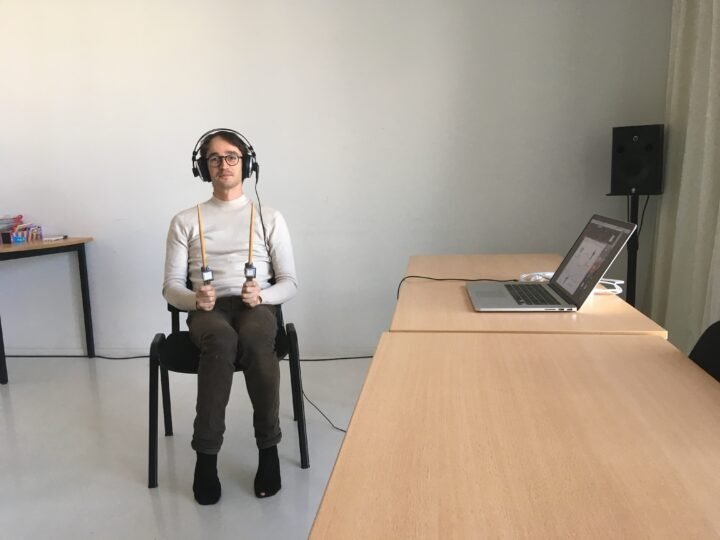
Introduction to somatic practices through the lens of awareness (meditation, yoga & kalarippayattu, three South Indian techniques of perception). - Micro-movements & gestures of listening; Introduction to bodily feedback.
- Same experiment, sensor-mediated.
- Work in pairs (gesture–sound resonance) / dancer-sound artist or anthropologist – sound artist.
- Proposing a media-lab: gestures / sensors / sounds
See some reference here.
- Body improvisations guided by sound.
Final objective
To produce short gestural scores (or performance; or documented performance) in which listening is analysed and described.
Workshop 3. Situated Sound Ecologies
Listening to the communities
General objective
Working with listening in various environments; engaging with communities.
This workshop extends the broader inquiry into listening as a situated and relational practice, where engaging with communities through sound also involves the co-production of sonic archives that, in turn, generate new communities of listening.
Research Question
What kind of methodologies or tools can we develop to co-create a sound archive with specific community members?
In this session, students are invited to develop a project in collaboration with a community of their choice (e.g., visually impaired or deaf individuals, migrants, elderly people, children, autistic participants, single mothers, non-human communities are a possibility field for exploration etc.)
NB: Issues related to establishing contact and addressing ethical considerations in this form of community engagement will be discussed during the online seminar.
Field recording (urban / natural).
Analysis of human / non-human relationships.Listening walk (soundwalks): create a sound walk protocol for the members of the community you are working with.
On what scale your sound protocol is operating: body, listening community members, city members?
Create composition from field recordings.
Archive your methodological process.
Sound mapping: questions of how to represent sounds on a map?
Create a collective archive.
Final objective
To create a situated collective sound archive. Parts of the archives will be presented to the festival & symposium.
Workshop 4.
Low-Tech Approaches & Creative Misuse
General objective
Questioning technological tools and their perceptual implications.
This workshop continues the exploration of listening as a situated and embodied practice, where listening is not only perceptual but also political: as a form of care, it shifts our attention from relations of extraction and control toward relations of reciprocity, reopening the possibility of thinking and inhabiting the world otherwise.
Research Question
How does the use of technologies affect the gestures of listening?
Experimentation with simple (or repurposed) sensors.
Critical analysis of devices (what they reveal / conceal).
Construction of DIY micro sound systems.
“Less technology, more relationship”?
Playing with existing objects.
Invention of sound and gestural scores with or without technologies. How does the use of digital technologies affect notation of a score? The score writing/edition?
Final objective
To produce a minimal sound prototype for an installation or a performance. The installation or performance will be invited in the festival
Workshop 5.
Co-creating a Form of Listening
General objective
Transforming explorations into a collective apparatus.
This workshop situates listening as a collective and political practice, where improvisation, curation, and spatialization allow prior explorations to be assembled into a shared apparatus. In doing so, it proposes listening not as a fixed skill but as a co-produced epistemological and relational infrastructure.
Research Question
How do collective processes of improvisation, curation, and spatialization give rise to new forms of listening?
-
-
Assembling materials from previous workshops for a festival = curating work
-
Guided collective improvisation design.
-
Spatialization (installation / performance / situation).
-
Final reflective symposium: What is a “form of listening”?
Final objective
To produce an exhibition & a symposium in the form of a festival over the last two days Performance, installation, open protocol, talks, roundtables and discussion.
Expected commitment from students
Students may attend all workshops, or choose to attend one or several, as each teaching unit is independent. However, attendance at at least one of workshops 1–4 is a prerequisite for participation in the fifth.